
Fastest Delivery and Low MOQ Development with Money Back Guarantee...
(213)-426-1030
info@customrubbersiliconemolds.com
Fastest Delivery and Low MOQ Development with Money Back Guarantee...

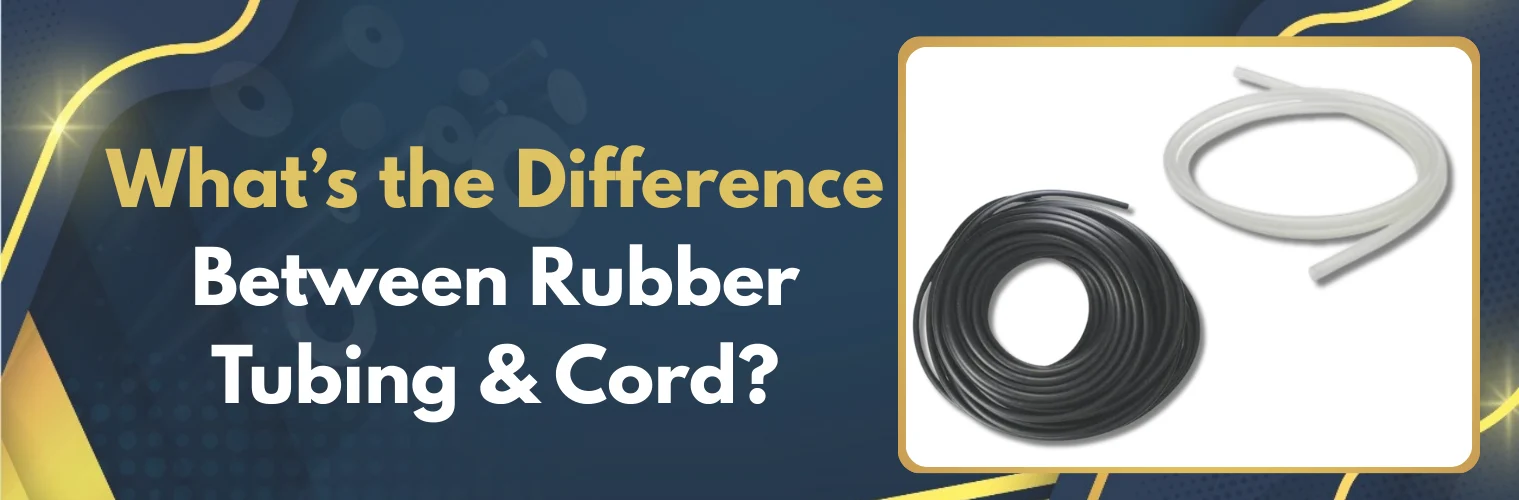
Rubber products are used in every industry from manufacturing and automotive to medical devices, laboratories, and DIY hobbies. Two of the most common forms you’ll encounter are rubber tubing and rubber cord. Though they may look similar at first glance, they serve very different purposes. Misunderstanding their differences can lead to choosing the wrong product, which can affect performance, durability, and safety.
In this comprehensive guide, we’ll break down what rubber tubing and rubber cord are, how they differ, and when you should choose one over the other.
Rubber tubing is a flexible, hollow cylinder made from natural or synthetic rubber. Its standout characteristic is the open internal channel that allows liquids, gases, powders, or small objects to pass through. Available in a wide range of inside diameters (ID), outside diameters (OD), wall thicknesses, and durometers (hardness levels), tubing is engineered for both general and highly specialized applications.
Common Characteristics
Medical & Laboratory: Silicone and latex tubing are staples for IV lines, peristaltic pumps, fluid transfer, and lab setups due to their biocompatibility and resistance to extreme temperatures.
Industrial & Automotive: Fuel lines, coolant systems, air hoses, and pneumatic tools rely on robust rubber tubing that can handle pressure and chemical exposure.
Food & Beverage: Food-grade tubing supports beverage dispensing, brewing, and dairy processing.
Home & Hobby Applications: Aquarium airlines, slingshot bands, gardening irrigation, and small machinery often use rubber tubing for easy flow and flexibility.
In essence, if your application requires movement of fluids, air, or materials, rubber tubing is the obvious choice.
Rubber cord—often called solid rubber cord or rubber rope—is a solid, cylindrical strand of rubber with no hollow center. It is manufactured in various diameters and durometers just like tubing but offers different performance traits because it is solid.
Common Characteristics:
Seals and Gaskets: Solid rubber cords are frequently cut and spliced to form O-rings, custom gaskets, and sealing systems for enclosures, machinery, and automotive parts.
Shock Absorption & Vibration Control: Because rubber cord compresses and rebounds well, it works in vibration isolation, cushioning systems, and impact-reducing setups.
Elastic Applications: Natural latex cord is commonly used for slingshots, bungee-related products, exercise equipment, fishing spearguns, and other high-strength elasticity needs.
Decorative or Craft Purposes: Rubber cord can be used as jewelry support, in leatherwork, or as lacing for crafts.
Whenever you need stretch, strength, sealing, or impact resistance—not fluid transport—rubber cord is often the ideal material.
Although both products come in similar materials and diameters, their functional differences are significant. Here’s how they compare in the areas that matter most.
A. Structure: Hollow vs. Solid
This single feature defines nearly every other difference: tubing is made for flow, while cord is made for structural or elastic tasks.
B. Flexibility & Elasticity
Both products offer flexibility, but:
Both tubing and cord can be made from identical materials, but the way those materials are used changes:
Still unsure which one you need? Here are some real-world examples that make the decision clear.
Choose Rubber Tubing If:
Examples:
Beer brewing lines, coolant systems, infusion pumps, lab setups, aquarium airlines, home irrigation.
Choose Rubber Cord If:
Examples:
Door seals, slingshots, bungee systems, vibration cushions, speargun bands, sealing grooves.
While they may appear similar, rubber tubing and rubber cord fulfill very different roles. Tubing is engineered for transport and flow, while cord excels in sealing, stretching, and absorbing force. Understanding their structural differences—hollow versus solid—helps determine which product is right for your application. If your project involves fluid movement, pressure lines, or medical or lab use, rubber tubing is the natural fit. If you need durability, elasticity, or sealing power, rubber cord will likely serve you better.
By selecting the correct material form, you not only improve performance but also increase the lifespan and reliability of your system. Whether you're upgrading equipment, designing a new product, knowing the difference between the two ensures you get the results you want.


