
Fastest Delivery and Low MOQ Development with Money Back Guarantee...
(213)-426-1030
info@customrubbersiliconemolds.com
Fastest Delivery and Low MOQ Development with Money Back Guarantee...

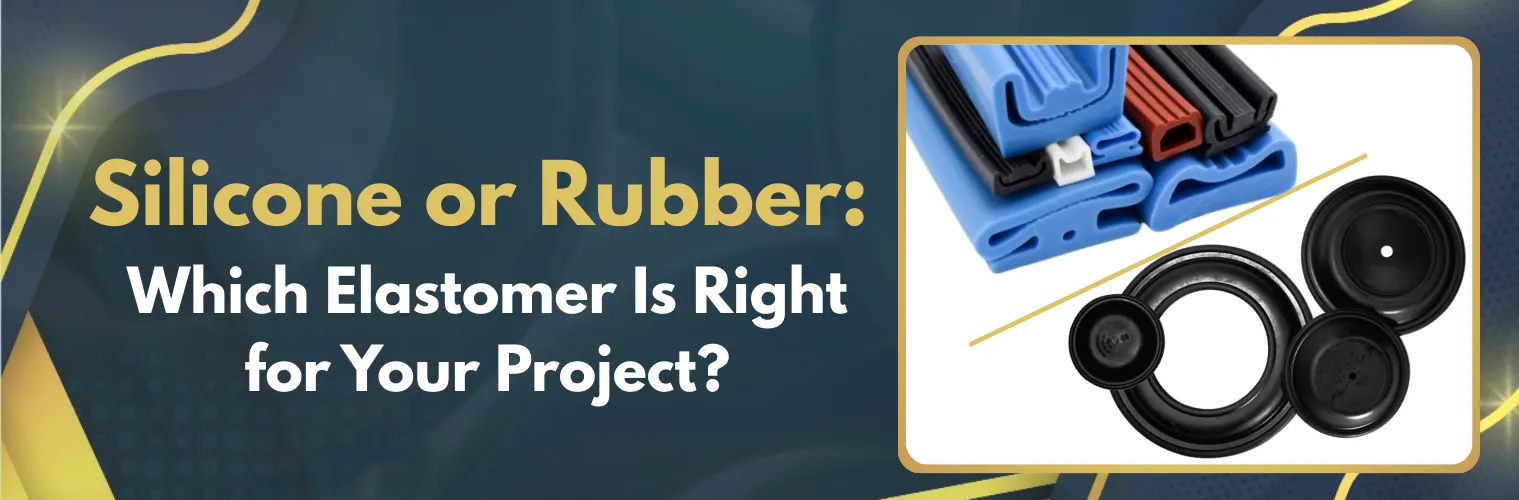
In the process of design of a new product, the choice of elastomer is usually one of the most important initial decisions. Regardless of whether you are coming up with a consumer product, a medical device, a car part, or an industrial tool, silicone or rubber might make a big difference in terms of performance, durability, cost, and regulatory compliance. Although both materials belong to the general group of elastomers, they have vast differentiation regarding the properties and application. These differences could be understood to assist engineers, manufacturers, and designers to make smarter and efficient decisions.
To make this decision, we have broken down the strengths, limitations and optimal applications of both materials below.
Silicone and rubber are commonly combined together due to the fact that they exhibit similar elastomeric behaviour, i.e. elasticity, flexibility, and deformation resistance. Nevertheless, they differ in terms of their chemical structures.
Silicone is an artificial elastic material that is composed of Silicon, oxygen, carbon, and hydrogen. It is anchored on siloxane chains which provide stability at a wide temperature range. Silicone may be designed in the form of liquid silicone rubber (LSR), high-consistency rubber (HCR) or room-temperature vulcanizing (RTV). This flexibility is used in the production of all types of products, whether it be a baby product or a medical implant.
Rubber can be natural, however, (NR), or synthetic (SBR, EPDM, NBR, neoprene, etc.). Every type of synthetic rubber has its performance profile. The chains of hydrocarbon-based structure of rubber render it harder in general, more abrasion-resistant and less expensive in terms of its industrial and automobiles uses.
In short:
To select the appropriate elastomer, one needs to have a realistic idea of what operating conditions your product will be exposed to. The following are the performances of silicone and rubber with regard to important parameters:
Temperature Resistance
Silicone: Outstanding thermal capabilities. Its temperature range is between -60C and +230 C and certain formulations can go even higher. Silicone does not break with the changing temperatures and will not decay.
Rubber: The type is dependent on temperature tolerance. Natural rubber hardens in cold conditions and decays around 100 o C. Silicone has better upper performance than specialty rubbers such as EPDM and fluorocarbon (FKM), which are very rare.
Chemical & UV Resistance
Tear, Abrasion and Mechanical Strength.
Most suitable when there is high stress: Rubber.
Compression Set Performance & Sealing Performance.
The various industries incline towards particular elastomers based on regulatory criteria, environment and the anticipated product life.
Lifestyle Products and Consumer Goods.
Choose Silicone When:
Choose Rubber When:
Choose Silicone When:
Choose Rubber When:
Silicone: Excellent thermal stability, high dielectric strength and superior electrical insulation. Predominantly used in keypads, protective covers and in high voltage application.
Rubber: Can be used as a general insulation, protective sheaths and in low temperature settings.
In addition to performance, one should take into consideration such factors as the efficiency of the production, tooling, and cost per part.
Cost & Availability
Rubber is generally less expensive, particularly when it is used in large and highly mechanical parts.
Silicone is also more costly because it is more costly to material and process particularly in medical grade or in food grade preparation.
Shaping and Forming Alternatives.
Both materials are used to facilitate a large number of production procedures, which include:
Silicone provides a greater range of freedom of soft-touch, ergonomic, or complex consumer designs. It is perfect in premium products because of its capacity to retain color, withstand fading, and endure different conditions.
The rubber is stronger and suited to heavy-duty functional parts as opposed to consumer products that are very aesthetic.
Whether to use silicone or rubber is solely dependent on the performance needs of your project, budget, environment and regulatory requirements. Silicone should be used when your product requires safety, durability, biocompatibility or high temperature resistance. Use rubber in cases when strength, durability, cost-effectiveness, or oils/fuels resistance are required. In most situations an ideal solution would be to collaborate with a manufacturer that is well versed in silicone and rubber casting.


