
Fastest Delivery and Low MOQ Development with Money Back Guarantee...
(213)-426-1030
info@customrubbersiliconemolds.com
Fastest Delivery and Low MOQ Development with Money Back Guarantee...

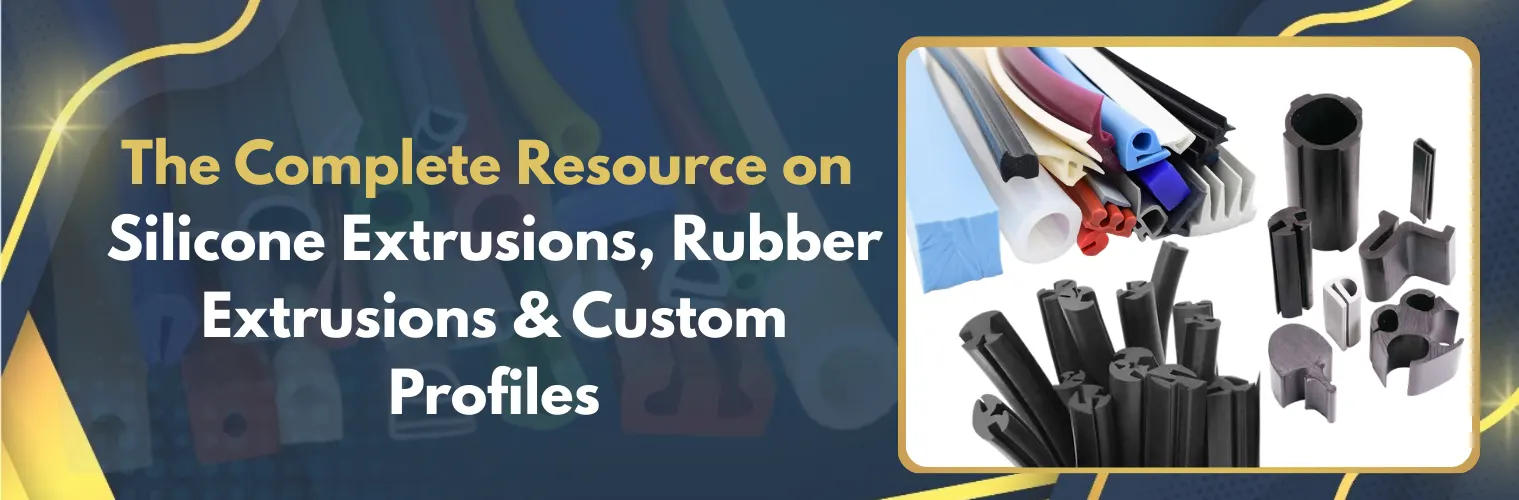
In the medical equipment business, as with automotive systems, consumer goods, construction, aerospace, energy, and others, extruded elastomer components are used in sealing, insulating, vibration dissipation, and structural protection. Silicone and rubber extrusion is desired because of its flexibility, chemical resistance, and because it can be formed into very specific shapes. As the need to have custom solutions increased, extruded profiles have developed into performance based engineered parts.
This is a complete guide to all pertinent information about silicone extrusions, rubber extrusions, and the profiles: their manufacturing process, their application, and the differences between materials and how to select the correct extrusion to fit your project.
Extrusion is a manufacturing process, which forces material through a shaped die to form a continuous length of elastomer profiles in long, continuous lengths as tubes, cords, strips, gaskets, seals, and more complex shapes. The power of extrusion is that it produces a steady, repeatable cross-section when needed in any length needed -this is good when needed to bond or seal in production.
The Extrusion Process
Silicone and rubber are different in terms of formulation but the overall extrusion process usually contains:
Silicone extrusions are characterized by high-quality performance and versatility, and thus they cannot be done away with in areas that have high environmental and regulatory requirements.
The main Characteristics of Silicone Extrusions:
Types of Silicone Extruded Profiles
Industries which use Silicone Extrusions
Silicone is the best solution in the extreme environment, long-lasting reliability, and controlled applications where safety and cleanliness are the main factors. Silicone may be the better elastomer in situations where you desire to have heat withstand, chemical stability or a critical geometry.
Rubber extrusions are designed and manufactured using synthetic or natural elastomers which make them strong, tough and cost-effective. Rubber is superior to silicone in mechanical life as well as resistance to abrasion, oils, fuels and physical wear.
Basic Rubber Materials used in Extrusion
The benefits of Rubber Extrusion
Industries that depend on extrusions made of rubber
Where the environment includes abrasion, heavy mechanical stress, oils, fuels, or where the cost is an issue, the better choice is rubber. It cannot be compared to other rough industrial applications whereby durability is the most important thing.
In some cases, extrusions of the standard shape are unable to satisfy the exacting needs of engineering with growing product complexity. It is where custom extruded profiles come in. These are profiles that have been designed with precise dimensional, mechanical and functional requirements.
Each of the silicone and rubber extrusions has distinct product development advantages: Select silicone extrusion in cases where your need is high temperatures, biocompatibility, or wear or those that require finer detailing. Use rubber extrusion when toughness, oils resistance, mechanical strength and cost-efficiency are of concern. Select custom extruded profiles when your project needs a unique sealing, functional or structural need that cannot be satisfied by the standard profiles.


