Mistakes to Avoid When Designing Rubber Extrusions
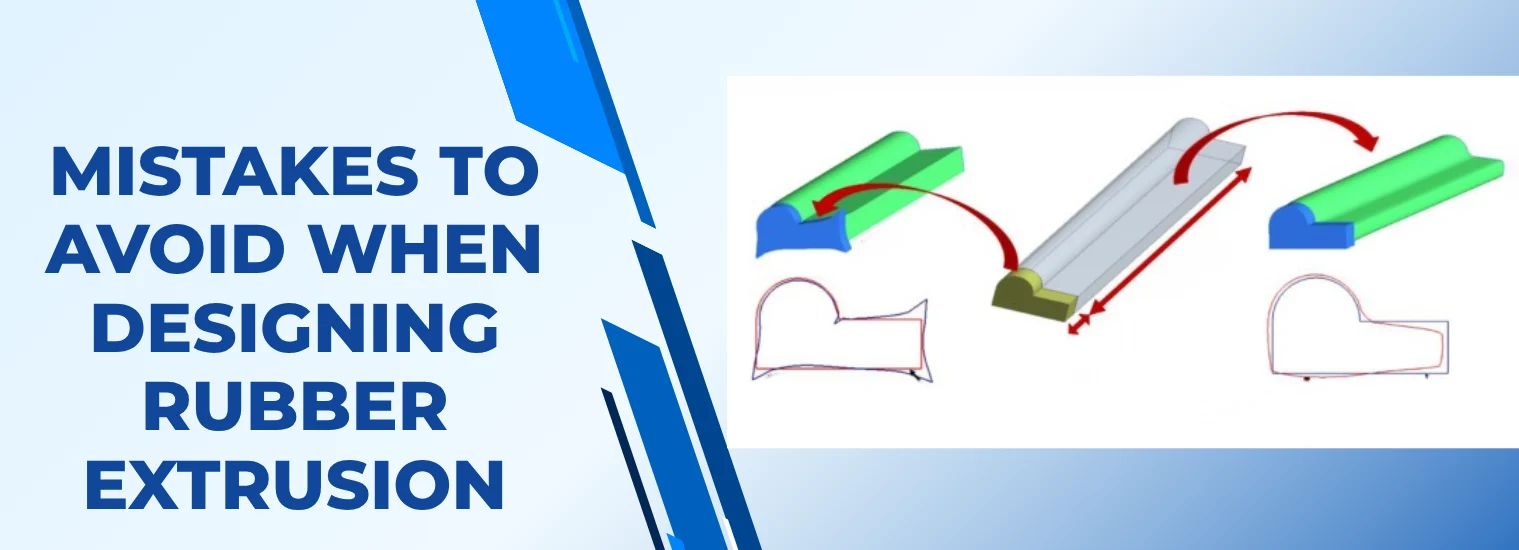
At first, it might seem that designing rubber extrusions is simple as you just draw a shape, choose a rubber, and initiate the production. However, many projects either fail or become significantly more expensive due to mistakes made at the design stage, which could have been easily avoided. By comprehending these common pitfalls in rubber extrusion design, one can conserve valuable time, minimize revisions, and ultimately achieve a component that functions optimally in operational environments. The most significant mistakes in the conception of rubber extrusions are listed below, along with a brief explanation and a few useful tips.
1. Ignoring the Application Environment
A common yet critical oversight involves neglecting to thoroughly consider the specific application and operational environment for a rubber extrusion. Without a proper consideration of the surroundings, seals can easily crack, stiffen, and lose their flexibility much earlier than anticipated.
Common issues:
- Using ordinary rubber in high-temperature conditions
- Choosing a material that easily swells in oil, fuel, or chemicals
- Ignoring UV exposure, ozone, water, or outdoor weather
How to avoid it:
- Take into account temperature, sunlight, water, and oil besides chemicals.
- Pick rubber compounds that are suitable for particular atmospheres.
- Verify the aging process over the long-term, not only the initial performance.
2. Choosing the Wrong Material Hardness (Shore A)
The hardness of the rubber is measured by a scale known as Shore A. The most significant mistake in the design of a rubber extrusion is the incorrect material selection. Each type of rubber, such as EPDM, silicone, nitrile, neoprene, SBR, FKM, and the rest, has specific properties.
Common issues:
- Using a rubber that cannot withstanding high temperature, UV rays, or chemicals.
- Choosing a material with an incorrect hardness can cause poor sealing or deformation.
- Not considering the compression set, which determines sealing over time.
How to avoid it:
- Always use material based on temperature, weather, oil, chemicals, and movement.
- Consult the manufacturer for the suitable hardness (durometer) and grade.
- Test the material at the design stage for real working conditions.
3. Overcomplicated Profile Design
Designers in some cases create extremely detailed shapes with thin walls, undercuts, and sharp corners without considering the manufacturability of the product. Besides being easier to extrude, a simple design will also be more stable when it is used in the real world.
Common issues:
- Hollow parts may collapse.
- Sharp corners are not forming properly.
- Profiles are twisting or losing size while cooling.
How to avoid it:
- Make the profile as simple yet functional as possible.
- Avoid using details that do not have functional value.
- If complexity is necessary, then use co-extrusion or secondary processes.
4. Wrong Tolerances for Extruded Rubber
A lot of designers use the tolerances for plastic or metal that rubber is not compatible with. Rubber is a flexible material, can be compressed and is influenced by temperature changes during extrusion process.
Common issues:
- Rejects during the QC stage due to a mismatch of dimensions with unrealistic tolerances.
- Profiles may not connect properly during assembly.
- Increased production cost due to frequent adjustments.
How to avoid it:
- Adhere to RMA tolerance guidelines when dealing with rubber extrusions.
- Keep in mind that rubber will expand and shrink during heating and cooling stages.
- Use realistic and functional tolerances rather than extremely tight ones.
5.Overlooking Joint and Corner Design
Different parts of an extruded rubber profile are cut and then joined with each other to make frames, gaskets, or seals. The joint, which is poorly designed, can cause a leakage or weak bonding. Properly designed joints are the primary requirement for both leak-proof and longer life span sealing.
Common issues:
- Rejects during the QC stage due to a mismatch of dimensions with unrealistic tolerances.
- Ends joining with poor bonding.
- Leakage in the gaskets of windows and doors
How to avoid it:
- Instead of sharp ones, you should design smooth, rounded corners.
- Ensure there is enough surface for bonding or vulcanization.
- Using molded corners can be your option for better strength and longer life.
6. Not Considering Compression and Seal Force
Designing with compression consideration will help you avoid the leakage of doors, windows, or enclosures. Rubber extruded products need to be properly compressed in order to work. The performance can be affected by either too much or too little compression.
Common issues:
- Under-compression causes leakage.
- Over-compression wears out the rubber.
- Profiles become less flexible due to a high compression set.
How to avoid it:
- Determine the required compression range for your application.
- Pick the rubber that has the right hardness and rebound.
- Ensure that the channel design is compatible with the intended compression
7. Not Considering Installation and Assembly
Even if an extrusion is properly designed, it can still fail if the installation requirements are overlooked. Besides that, wrong assembly may lead to situations such as leakage, misalignment, or even premature failure. With simple installation, you will get better product functionality, stability, and efficiency over the long term.
Common issues:
- Profiles stretching or shrinking during installation.
- Edges not fitting into the groove.
- Difficult assembly increases labor time.
How to avoid it:
- Provide for installation tolerances in the design.
- Take into account the assembly direction (push-in, slide-in, snap-fit).
- Ensure the profile has enough flexibility for its installation method.

Why Choose Custom Rubber Extrusion?
At Custom Rubber Extrusion, we are driven by core values that guide our business and define our commitment to our clients.

Expertise and Experience - With years of experience in the Extrusions industries, we have the expertise to deliver custom-designed solutions that meet the most demanding requirements.
High-Quality Products - Our ExtrusionsExtrusions are made from high-quality materials, ensuring durability, clarity, and long-lasting performance.
Custom Solutions - We specialize in providing tailored Extrusions solutions that meet the unique needs of our clients.
Exceptional Customer Service - We provide end-to-end support, from initial consultation to post-delivery assistance, ensuring our clients are delighted with the results.

Conclusion
It's not only about drawing a shape when you design rubber extrusions. The designer has to consider the environment, material selection, hardness, tolerances, installation, jointing, compression, thermal effects, cost, and testing as well. It is a fact that the majority of the time, the failure of rubber extrusions is not attributable to the errors of the manufacturing process, but to the improper or unrealistic decisions taken at the design stage. Hence, through the mere avoidance of the mistakes in design, you will be able to manufacture dependable, inexpensive, and durable rubber profiles that will suit your application requirements.