
Fast Delivery And Low MOQ With Money Back Guarantee...
Fast Delivery And Low MOQ With Money Back Guarantee...

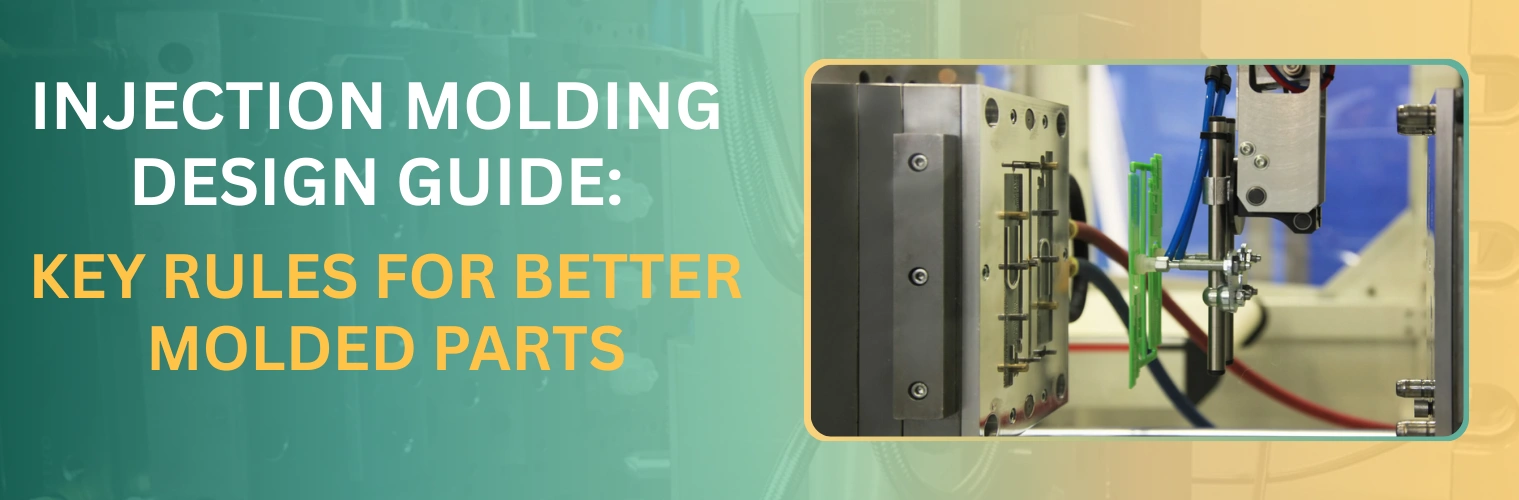
Designing for injection molding requires a mix of engineering precision, material understanding, and process awareness. When done correctly, it improves product performance, reduces manufacturing errors, and keeps manufacturing costs under control.
This Injection Molding Design Guide explains the essential rules every designer should follow to create parts that mold efficiently and maintain long-term durability.
Injection molding is a manufacturing method where molten plastic is injected into a mold cavity to form complex shapes. It is widely used because it supports high-volume manufacturing, ensures repeatability, and provides excellent surface finishes.
Key aspects to consider before starting the design include:
Understanding these fundamentals helps prevent defects early in the design stage.
Consistent wall thickness is one of the most important principles in Injection Molding Design Guide. Uneven walls cause issues like warpage, shrinkage, and sink marks because thicker areas cool more slowly. Keeping the thickness uniform ensures smooth material flow.
Best practices:
Following these steps greatly improves moldability and reduces cycle time.
When designers need to add stiffness to a component, ribs are the most effective structural feature. They strengthen the part without adding excessive material.
Guidelines:
Well-designed ribs make the part lightweight, strong, and easier to manufacture.
Draft angles help the molded part release smoothly from the mold. Without proper draft, parts stick to the core and cause ejection problems.
General rules:
Proper draft avoids costly mold repairs and prevents part damage during ejection.
Gates are the entry points through which molten plastic enters the mold cavity. Their placement directly affects flow patterns, weld lines, and shrinkage.
Factors to consider:
Correct gate placement ensures even filling and reduces costly defects.
Warpage occurs when different areas of the part cool at different rates, causing distortion. Shrinkage happens when plastic contracts during cooling.
Design adjustments during the early stages help avoid manufacturing delays later.
Choosing the right plastic material affects strength, cost, durability, and moldability. Designers must understand each plastic behavior during processing.
Key material considerations:
Tensile strength and flexibility
Heat resistance
Chemical stability
Flow characteristics
Cost and availability
Common choices include ABS, PP, PC, nylon, and PEEK depending on the application.
Sharp corners create stress concentration during molding and in the final product. They also restrict smooth flow of molten plastic.
Recommendations:
Rounded edges lead to stronger and more reliable molded components.
Undercuts further complicate mold design, requiring side action, lifters, or collapsible cores, ultimately increasing tooling costs.
Good practices:
Smart design decisions keep the mold efficient and affordable.
Before starting mass manufacturing, it is crucial to test the design using prototypes. This step ensures the part performs as expected.
Prototyping options:
Prototyping helps detect problems early and speeds up final production.
Cost efficiency is essential in high-volume manufacturing. Small changes in design can significantly reduce overall manufacturing expenses.
Ways to reduce cost:
A well-structured injection molding design leads to stronger parts, efficient manufacturing, and reduced manufacturing defects. By following best practices—such as consistent wall thickness, proper draft, optimized gating, and material selection—designers can achieve reliable and cost-effective results. This guide provides a strong foundation for anyone looking to improve their injection molding outcomes.
Need Expert Guidance Or Manufacturing Support? (CTA)
For professional injection molding services, mold design support, or material selection guidance, contact our team today: +1(917)-993-9690 or info@plastic-injectionmolding.com

